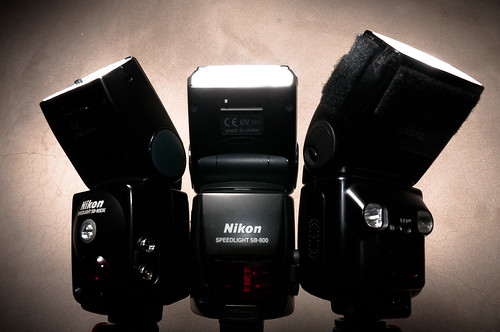
 |
| From left to right: the SB-80DX, the SB-800, and the SB-26 |
Showing posts with label "yong nuo". Show all posts
Showing posts with label "yong nuo". Show all posts
Friday, May 27, 2011
Old School


Monday, May 23, 2011
Is the YongNuo YN-560 a Headturner?
WARNING: I have ZERO evidence whether this works. You may kill your YN560 in the process. I am sure this will violate whatever warranty YongNuo or the seller may have. Do this at your own risk!!!
Monday, January 24, 2011
Alas poor YN-560!
It must have started about a week ago, when I was looking around at a camera store and saw a Yongnuo YN460-RX flash -- Yongnuo's latest flash, with built-in radio manual and radio TTL remote adjustment. My poor YN560 sensed that I was a little distracted and knew something was going on. It put two and two together, figured its days were numbered, and formulated a plan.
The YN560 saw its opportunity when we went to the beach this past weekend. I used the YN560 as an off-camera flash, mounted on a Propet umbrella bracket, firing through a Creative Light translucent umbrella. For these shots, I waded into the water with our toddler.

As I was taking some photos, the YN560 found a way to loosen itself and dive into the water...! I looked around in time just to see it splash into the water and fire its last pulse of flash, giving up its soul. "I served thee well, master, as best as I could," it seemed to say. "Through the drop tests and open heart surgery, I came through for you ... I hope you like the images I helped you get and that you'll find happiness with your next flash!" And that was the last time its Xenon bulb would ever shine again.
I grabbed it without hesitation - stupidly perhaps - getting a little electric shock in the process. I rushed it back to shore and took out the batteries, which felt extremely hot. However, even I knew it was too late. No amount of drying or exchanging batteries would bring the spark back into the little YN560.
Oh, YN560, if you only knew - I had no plans to replace you. With your ability to sync at extra-high sync speeds without the aid of HSS, and Matrix-style reflexes enabling optical sync at 1/8000 shutter speed, I could always use your photons. You were content to let the SB-800 grab the headlines, even though it was your rim light that made my shots look a little better. You helped me cheat the shutter's twin razor blades when the mighty SB-800 could not. Together we broke the CLS code. You even helped me sell a house and a crib. And how could I forget that you helped me learn manual flash? Ah, little YN-560, you worked as hard as the underpaid laborers who made you. Farewell!
The YN560 saw its opportunity when we went to the beach this past weekend. I used the YN560 as an off-camera flash, mounted on a Propet umbrella bracket, firing through a Creative Light translucent umbrella. For these shots, I waded into the water with our toddler.

As I was taking some photos, the YN560 found a way to loosen itself and dive into the water...! I looked around in time just to see it splash into the water and fire its last pulse of flash, giving up its soul. "I served thee well, master, as best as I could," it seemed to say. "Through the drop tests and open heart surgery, I came through for you ... I hope you like the images I helped you get and that you'll find happiness with your next flash!" And that was the last time its Xenon bulb would ever shine again.
I grabbed it without hesitation - stupidly perhaps - getting a little electric shock in the process. I rushed it back to shore and took out the batteries, which felt extremely hot. However, even I knew it was too late. No amount of drying or exchanging batteries would bring the spark back into the little YN560.
Oh, YN560, if you only knew - I had no plans to replace you. With your ability to sync at extra-high sync speeds without the aid of HSS, and Matrix-style reflexes enabling optical sync at 1/8000 shutter speed, I could always use your photons. You were content to let the SB-800 grab the headlines, even though it was your rim light that made my shots look a little better. You helped me cheat the shutter's twin razor blades when the mighty SB-800 could not. Together we broke the CLS code. You even helped me sell a house and a crib. And how could I forget that you helped me learn manual flash? Ah, little YN-560, you worked as hard as the underpaid laborers who made you. Farewell!
Sunday, September 26, 2010
Preview of Yongnuo's radio commander and speedlight: YN460-TX and YN460-RX
LightingRumours.com posted Yongnuo's official announcement of its radio commander and speedlight, the YN460-TX and YN460-RX. I downloaded the demo videos from Yongnuo's website, which weren't exactly crystal clear, and tried to figure out how the commander and flash work.
First of all, the system seems independent from the camera's wireless flash system (such as Nikon's Advanced Wireless Lighting). Briefly, the system appears to allow radio TTL and manual capability with remote adjustment.
COMPONENTS:
There is a commander unit called the YN460-TX (which looks like the Nikon SU-800). The TX commander is designed to be attached to the camera hotshoe and apparently can emit an AF assist light. However, it also appears that the TX can be used off-camera (query whether the TTL capabilities would remain). According to Yongnuo, the TX commander can control up to 16 dedicated speedlights (YN460-RX), each of which has built-in radio capability.
HOW IT'S USED:
The TX commander controls 3 groups simultaneously: a TTL group (TTL), Manual group 1 (M1), and Manual group 2 (M2). To assign an RX flash to a group, you press the RX flash's mode button until the RX selects WT (for the TTL group), M1, or M2. In addition to the WT, M1, and M2 mode, the RX unit has another wireless mode, WX which allows it to function either on manual or TTL, as explained below.
Wireless Manual:
Group M1: once an RX flash is assigned to M1, its power level can be selected by choosing the M1 group on the TX unit then adjusting the power level. There are 7 power levels, in full stops from full power to 1/64 power. There are no power indicators per se -- you have to count the number of LEDs lit. 1 LED = 1/64, 2 LEDs = 1/32 etc.
Group M2 functions similarly. Its power is selected by choosing the M2 group on the TX and adjusting the power level.
Wireless TTL: This was not clearly demonstrated in the videos. It appears that TTL flash exposure can be adjusted from -3 to +3 FEC. The video demo'd adjustment of FEC directly on the RX flash. The videos did not demo wireless adjustment of FEC with the TX commander, though it seems the TX commander should have this capability because its LEDs are labeled -3 to +3, which wouldn't make sense except for TTL.
WX mode of the RX flash: In WX mode, the RX flash will match the CURRENTLY SELECTED mode of the TX commander. By contrast, if the RX is in WT mode, it will stay assigned to the TTL group, and if it is in M1 or M2 mode, it will stay in M1 group or M2 group respectively. On the other hand, by using the RX flash in WX mode, it can join group WT, M1 or M2 as needed. If the user wants the RX (on WX mode) to join the TTL group, then the user simply has to remember to switch the TX to TTL mode when he is ready to shoot. If the user wants the RX on WX mode to join the M1 or M2 group, the user simply switches the TX to M1 or M2 respectively immediately before shooting.
The WX mode is useful when you only have one RX flash, allowing you to switch from TTL to manual anytime. It is useful also if you want one of your RX flashes to be flexible and join any of the other groups as needed.
OTHER NOTES:
First of all, the system seems independent from the camera's wireless flash system (such as Nikon's Advanced Wireless Lighting). Briefly, the system appears to allow radio TTL and manual capability with remote adjustment.
COMPONENTS:
There is a commander unit called the YN460-TX (which looks like the Nikon SU-800). The TX commander is designed to be attached to the camera hotshoe and apparently can emit an AF assist light. However, it also appears that the TX can be used off-camera (query whether the TTL capabilities would remain). According to Yongnuo, the TX commander can control up to 16 dedicated speedlights (YN460-RX), each of which has built-in radio capability.
HOW IT'S USED:
The TX commander controls 3 groups simultaneously: a TTL group (TTL), Manual group 1 (M1), and Manual group 2 (M2). To assign an RX flash to a group, you press the RX flash's mode button until the RX selects WT (for the TTL group), M1, or M2. In addition to the WT, M1, and M2 mode, the RX unit has another wireless mode, WX which allows it to function either on manual or TTL, as explained below.
Wireless Manual:
Group M1: once an RX flash is assigned to M1, its power level can be selected by choosing the M1 group on the TX unit then adjusting the power level. There are 7 power levels, in full stops from full power to 1/64 power. There are no power indicators per se -- you have to count the number of LEDs lit. 1 LED = 1/64, 2 LEDs = 1/32 etc.
Group M2 functions similarly. Its power is selected by choosing the M2 group on the TX and adjusting the power level.
Wireless TTL: This was not clearly demonstrated in the videos. It appears that TTL flash exposure can be adjusted from -3 to +3 FEC. The video demo'd adjustment of FEC directly on the RX flash. The videos did not demo wireless adjustment of FEC with the TX commander, though it seems the TX commander should have this capability because its LEDs are labeled -3 to +3, which wouldn't make sense except for TTL.
WX mode of the RX flash: In WX mode, the RX flash will match the CURRENTLY SELECTED mode of the TX commander. By contrast, if the RX is in WT mode, it will stay assigned to the TTL group, and if it is in M1 or M2 mode, it will stay in M1 group or M2 group respectively. On the other hand, by using the RX flash in WX mode, it can join group WT, M1 or M2 as needed. If the user wants the RX (on WX mode) to join the TTL group, then the user simply has to remember to switch the TX to TTL mode when he is ready to shoot. If the user wants the RX on WX mode to join the M1 or M2 group, the user simply switches the TX to M1 or M2 respectively immediately before shooting.
The WX mode is useful when you only have one RX flash, allowing you to switch from TTL to manual anytime. It is useful also if you want one of your RX flashes to be flexible and join any of the other groups as needed.
OTHER NOTES:
- Uses 2.4ghz frequency. Up to 200m range claimed.
- 7 available channels. (By contrast, Nikon's Advanced Wireless Lighting has only 4 channels.)
- Supports rear curtain sync, flash exposure compensation (FEC) and "FEB" (flash exposure bracketing??)
- There is a blue LED light to show that a link between the TX and RX has been established.
- The TX appears to have 2 ports, one of which appears to be a PC sync.
- The RX flash can also function on non-wireless manual mode. It is not clear whether it can function as a non-wireless TTL flash.
- LightingRumours.com, citing De.Rec.Fotografie, states that cost will be 200 euro for a TX and RX kit. Availability is estimated to be within the next 2 months, direct from Yongnuo's ebay site with a 12-month warranty: http://stores.ebay.com/hkyongnuophotoequipment .
Wednesday, August 18, 2010
YongNuo YN-560 Label

I like the interface of the YN-560 because I find it simple and quick to make adjustments. But one of the things that took getting used to is the absence of a label for the power level. Instead, you have to count the number of LEDs that are lit in order to determine the power setting or the adjustments in 1/8 EV steps. David Hobby lamented this in his review of the YN-560.
Fortunately, there's a space above the LEDs that can be conveniently used for a label. I experimented with different font sizes and margins and found one that worked reasonably well. A PDF version is below. If you wish to modify it, you can get the Word version instead. (I believe the files have no viruses but please double-check. I don't want to be an unwitting accomplice in spreading any malware.)
I printed the label on an Avery label then cut it to size, leaving just a thin border around the label itself. With the thin border, the sticker can be aligned with the edge of the display window on the back of the flash and will be exactly the width of the display window.
Word format:
PDF format:
Monday, August 16, 2010
Yongnuo YN-560 Zoom Repair
CAUTION: a flash can contain dangerous amounts of electricity. You can die. Do this at your own risk.
Feelingsuicidal (ahem) "terribly disappointed" about our toddler's birthday photos, I attempted the dangerous task of repairing my Yongnuo YN-560 flash. After all, my life insurance premiums were current... (no pun intended).
In all seriousness, I dropped my YN-560 by accident. Although the flash still worked, the zoom ceased to function. I attempted these repairs after being encouraged by a commenter (or two) who also provided a helpful link to instructions for repairing the zoom on a Nikon SB-600. I'm not a handy person at all and I don't even know for sure how the repair below worked, but it worked. Here's what I did.
Link to photos: http://picasaweb.google.com/creadvty/YongnuoYN560Repair#
Step 0: try to discharge the electricity in the capacitor. I set the flash to full power, pressed the test button, then immediately opened the battery cover. Then I waited several hours.
Step 1: remove the rubber covers on the sides of the flash head. I used a small flathead screwdriver to pry the cover off, which was glued to the flash head.

Step 2: remove the metal clips near the hinge. There are two metal clips on each side of the flash head. I removed them by prying them off with a small flathead screwdriver.

Step 3: remove the screws on the bottom of the flash head.

Step 4: pull the flash head apart. Mine seemed to have some sort of rubber glue holding it together.

When you pull the flash head apart, you'll find a piece of plastic that seems to be for holding the wires together and maybe protecting them from external elements (?).

Step 5: remove the 2 screws holding the flash head body to the top of the flash head cover (circled in red in the picture).

Step 6: you'll see that the top of the flash head body has a screw drive. I did not find any damage on the screw drive on my flash, so I was at a loss as to what to do to fix it. Not having anything better to do with it, I rolled the screw drive with my fingers (warning: it's oily) until the flash moved to the most zoomed position (with the flash bulb furthest away from the edge of the flash head) so that I could have the benefit of the high GN at a cost of decreased coverage.

When I put the flash back together, I noticed that the sound was a bit different, and I tested the zoom. I was shocked that the zoom worked.
24mm:

105mm:

Feeling
In all seriousness, I dropped my YN-560 by accident. Although the flash still worked, the zoom ceased to function. I attempted these repairs after being encouraged by a commenter (or two) who also provided a helpful link to instructions for repairing the zoom on a Nikon SB-600. I'm not a handy person at all and I don't even know for sure how the repair below worked, but it worked. Here's what I did.
Link to photos: http://picasaweb.google.com/creadvty/YongnuoYN560Repair#
Step 0: try to discharge the electricity in the capacitor. I set the flash to full power, pressed the test button, then immediately opened the battery cover. Then I waited several hours.
Step 1: remove the rubber covers on the sides of the flash head. I used a small flathead screwdriver to pry the cover off, which was glued to the flash head.
Step 2: remove the metal clips near the hinge. There are two metal clips on each side of the flash head. I removed them by prying them off with a small flathead screwdriver.
Step 3: remove the screws on the bottom of the flash head.
Step 4: pull the flash head apart. Mine seemed to have some sort of rubber glue holding it together.
When you pull the flash head apart, you'll find a piece of plastic that seems to be for holding the wires together and maybe protecting them from external elements (?).
Step 5: remove the 2 screws holding the flash head body to the top of the flash head cover (circled in red in the picture).
Step 6: you'll see that the top of the flash head body has a screw drive. I did not find any damage on the screw drive on my flash, so I was at a loss as to what to do to fix it. Not having anything better to do with it, I rolled the screw drive with my fingers (warning: it's oily) until the flash moved to the most zoomed position (with the flash bulb furthest away from the edge of the flash head) so that I could have the benefit of the high GN at a cost of decreased coverage.
When I put the flash back together, I noticed that the sound was a bit different, and I tested the zoom. I was shocked that the zoom worked.
24mm:
105mm:
News flash! YN-560 zoom FIXED
Incredibly, I fixed the flash on my YN-560 at the suggestion of a helpful commenter. :-O (Kindly stand up and be recognized, sir... :) ). It wasn't as easy as I thought it might be but was not hard either. I will post shots. Caution: I don't know if the fix I did will work for other YN-560 units with zoom issues.
UPDATE: Link to repair here: http://betterfamilyphotos.blogspot.com/2010/08/yongnuo-yn-560-zoom-repair.html
UPDATE: Link to repair here: http://betterfamilyphotos.blogspot.com/2010/08/yongnuo-yn-560-zoom-repair.html
Sunday, August 1, 2010
YongNuo YN-560 flash - update

I did a few more tests to follow up on my initial impressions.
1. Optical slave: Infrared not visible light.
I discovered that the YN-560's optical slave detects infrared light not visible light. This is useful if we want to avoid any contribution from the triggering flash, by covering it with an infrared filter such as the SG-3IR.

In the image above, I used the popup to trigger the YN-560 but covered the popup with an the SG-3IR, yet the YN-560 triggered successfully.
2. Sync speed:
An interesting discovery is that the YN-560 can sync at 1/3 stop higher than the natural sync speed, whether on-camera or on either optical sync mode, with only a very slight reduction in power.
Baseline shot at normal sync speed: ISO 200, f/32, 1/250, YN-560 at full power, on-camera:

Test shot: same as above at 1/320, YN-560 on-camera:

Test shot: ISO 200, f/32, 1/320, YN-560 on S1 mode, popup flash at Manual mode 1/128 with SG-3IR infrared filter:

Test shot: ISO 200, f/32, 1/320, YN-560 on S2 mode, popup flash at TTL mode -3 FEC with SG-3IR infrared filter:

Note: in the latter two shots, the white balance is correct because the camera is aware that flash is being used, and Nikon's CLS corrects white balance for flash use. In the first two shots, the camera acted as though it was not aware that a flash was fired, therefore there was no white balance correction.
Another interesting discovery is that when the YN-560 is on-camera, the camera does not limit the shutter speed to 1/250. This allows trick shots like the one above.
In the shot above, I used the YN-560 on-camera to trigger the SB-800 on SU-4 (optical slave) mode. The flash appears invisible on the SB-800's flash head although it lights up my face, because the flash is blocked by the rear curtain but its light on my face is not. The flash unit itself is not obscured by the rear curtain however because it is illuminated by the ambient light from the sun.
3. Flash duration:
The published specifications for the YN-560 state that at full power, the flash duration is 1/200. That is incredibly slow for a hotshoe flash (the SB-800 claims a flash duration of 1/800 at full power). If the 1/200 flash duration is true, then at a sync speed of 1/250, you wouldn't get full power - instead you would get 1/3 of a stop less power (i.e., around 16.67% less power).
To test flash duration, I used a point and shoot camera, the Casio Exilim EX-V7 (which has no mechanical shutter and can theoretically sync at any speed), and compared the output of the YN-560 at speeds from 1/125 to 1/800 (the highest shutter speed on my point and shoot). My point and shoot only has TTL flash, therefore I used the YN-560's digital optical slave (which ignores preflashes). I set the Casio's flash to -2 FEC and covered it with an SG-3IR.
a. Baseline shot (showing ambient "deleted") ISO 64, f/10.6, 1/125.

b. YN-560 @ full power, ISO 64, f/10.6, 1/125:

c. same as above, at 1/200:

d. same as above at 1/640:

e. same as above, at 1/800:

Conclusion: the fastest shutter speed where there is no noticeable decrease in flash exposure at full power is 1/640. At 1/800 there is a very slight reduction in flash exposure, presumably from clipping of flash duration. Speeds higher than 1/800 were not tested.
4. Power:
There had been conflicting results regarding the YN-560's power. Earlier reports found the power to be similar to an SB-600. However, it appears there is now a consensus that the power is similar to an SB-800:
- Following a test of a production model, Speedlights.net found the power to be the same as a YN-460 II, which is greater than an SB-600 and almost identical to an SB-900, with an approximate GN of 33 meters at 35mm zoom and ISO 100.
- Strobist Flickr group member Kurbster found the YN-560 to yield an aperture of f/32 at a distance of 1 meter at ISO 100, implying a GN of 32 meters.
5. TTL Accuracy with CLS AWL
As previously posted, it is possible to synchronize the output of the YN-560 with a commander flash and a slave flash operating using Nikon's CLS Advanced Wireless Lighting. One question is whether TTL flash exposure remains accurate when the YN-560 is contributing light. It would seem that it the answer should obviously be no because the YN-560 doesn't fire during the TTL preflashes, therefore its output is not taken into account in the TTL flash metering. However, I was hoping that after the TTL preflashes fire, it specifies the flash exposure instead of flash output, and thus it would be possible for the YN-560 to avoid skewing the TTL accuracy.
To test whether TTL accuracy is affected by the YN-560's contribution, I fired an SB-800 on-camera and used it to trigger a YN-560 in a dual flash bracket. For the baseline shot, I lit a subject with just the SB-800 on TTL mode. I then did a test shot with the YN-560 contributing light and compared the two exposures for similarity.
Baseline shot: f/11, 1/250, ISO 200, SB-800 on TTL (0 FEC).

Comparison shot: f/11, 1/250, ISO 200, SB-800 on TTL (0 FEC) and YN-560 at 1/16 power.

Evidently, TTL accuracy is affected by the YN-560.
6. Other observations:
- My unit didn't come with a sto-fen type diffuser. That's ok. I very rarely use them anyway. Come to think of it, I don't recall ever using one other than for testing purposes because diffusion doesn't soften light.
- I agree with other reviewers that the pilot light (test light) is harder to press than the other buttons but doesn't take THAT much effort. It's just stiff, that's all.
- The sound button (also functions as the power save button) occasionally doesn't respond.
Tuesday, July 27, 2010
YongNuo YN-560 drop test
My recently received YN-560 went through a drop test. Rest assured I did not do it intentionally (heaven knows I haven't made a dime out of this blog! :)) ).
My flash dropped from a height of 3 feet to a solid stone floor. It was actually more than just dropped. I was cleaning my bag and shaking off sand (our toddler dumped sand into my camera bag... argh). I thought my zipper was completely closed but it wasn't -- and as I shook the bag downward, the flash fell with a loud bang against the floor. I believe the flash head hit first.
After the drop, the flash was still functioning (including the strange digital optical slave mode)... except for the zoom. When I turn on the flash I can hear a short, loud hum (presumably the zoom motor). When I adjust the zoom, the lights change but the zoom doesn't work anymore. So my unit is stuck at 70mm. :( At least the built-in diffuser still works...
UPDATE: YN-560 fixed!
My flash dropped from a height of 3 feet to a solid stone floor. It was actually more than just dropped. I was cleaning my bag and shaking off sand (our toddler dumped sand into my camera bag... argh). I thought my zipper was completely closed but it wasn't -- and as I shook the bag downward, the flash fell with a loud bang against the floor. I believe the flash head hit first.
After the drop, the flash was still functioning (including the strange digital optical slave mode)... except for the zoom. When I turn on the flash I can hear a short, loud hum (presumably the zoom motor). When I adjust the zoom, the lights change but the zoom doesn't work anymore. So my unit is stuck at 70mm. :( At least the built-in diffuser still works...
UPDATE: YN-560 fixed!
Friday, July 23, 2010
News Flash! YN-560 Syncs with Nikon CLS AWL!
I recently reported that I received a YN-560 flash which had some interesting surprises but failed to sync with the pop-up flash on commander mode. Through testing and experimentation, I found a specific set of settings that will allow the 560 to sync with the pop-up flash on commander mode. Will report the findings (and settings of course) this weekend.
UPDATE: Rules for syncing the YN-560 mapped out here
UPDATE: Rules for syncing the YN-560 mapped out here
Tuesday, July 20, 2010
Yong Nuo YN-560 first impressions and surprises
UPDATE 1: I found out how to make the YN-560 sync with the pop-up flash in commander mode! http://betterfamilyphotos.blogspot.com/2010/07/news-flash-yn-560-syncs-with-nikon-cls.html
UPDATE 2: other tests of the YN-560: http://betterfamilyphotos.blogspot.com/2010/08/yongnuo-yn-560-flash-update.html
-----
5. The optical slave (both modes) works even when I cover the flash with an SG-3IR infrared filter, implying that the YN-560 is triggered by infrared, not visible light. I plan to double check this (it's possible that the pop-up flash reflection from the SG-3IR was sufficient to trigger the YN-560).
UPDATE 2: other tests of the YN-560: http://betterfamilyphotos.blogspot.com/2010/08/yongnuo-yn-560-flash-update.html
-----
So I finally got the YN-560 today, a little less than 2 weeks after I ordered it. In the meantime, speedlights.net has posted a very thorough review of the YN-560, so I'll just mention the few things that I found so far that were new or different. I didn't have a lot of time to test it but because there's some possibly disappointing info, I wanted to bring this to potential buyers' attention right away. Note: the camera I used was a Nikon D300.
1. Power: I don't have a light meter, but based on my very unscientific test, I would guess that the power is closer to the SB800 (per Kurbster.com) not the SB600 (per speedlights.net). What I did was to put the 2 flashes approximately the same distance from the wall, side by side, then compared their output. The output looked identical in terms of intensity at 35mm zoom and at 105mm zoom, though the SB800 covered a slightly larger area. I plan to conduct more a more rigorous test (by comparing the histograms) this weekend.
2. When the flash is attached to the camera, my camera acts like there is no flash, i.e., shutter speed is not limited to sync speed, even with Auto FP disabled. This is useful for trick shots like this one: http://strobist.blogspot.com/2008/08/on-assignment-50-years.html , and fortunately the rear curtain appears at the top of the D300's frame, which means shooting upside down is not necessary.
3. Whether on-camera or as an optical slave (either mode), the flash can sync at 1/320 with no noticeable decrease in output (at least on low power -- I plan to test this more thoroughly this weekend). At 1/400 and at higher speeds on-camera, the flash is visible but blocked by the rear curtain. At 1/400 off-camera (as optical slave), the flash output isn't visible at all.
4. The digital optical slave (which ignores the preflashes) works with TTL flash but not in CLS AWL commander mode. In commander mode the YN560 doesn't only fail to sync -- it doesn't fire at all. I tried various combinations of the popup flash being on TTL or manual, and the SB800 being on TTL, AA or Manual. I tried different channels, and assigning the SB800 to Group A or Group B. No combination worked except for the popup being on TTL and all other channels being deactivated (which is in effect just like using the pop-up on TTL mode). This is contrary to the experience of speedlights.net owner's fransener ( http://www.flickr.com/groups/strobis...7624196263437/ ), so I'm very disappointed but will conduct more tests. I've also contacted him to inquire. To be fair, the YN560's manual does state on p.33 that the digital optical slave is NOT designed to work for red-eye flash, Nikon's commander mode, or Canon's wireless flash (including the ST-E2).
1. Power: I don't have a light meter, but based on my very unscientific test, I would guess that the power is closer to the SB800 (per Kurbster.com) not the SB600 (per speedlights.net). What I did was to put the 2 flashes approximately the same distance from the wall, side by side, then compared their output. The output looked identical in terms of intensity at 35mm zoom and at 105mm zoom, though the SB800 covered a slightly larger area. I plan to conduct more a more rigorous test (by comparing the histograms) this weekend.
2. When the flash is attached to the camera, my camera acts like there is no flash, i.e., shutter speed is not limited to sync speed, even with Auto FP disabled. This is useful for trick shots like this one: http://strobist.blogspot.com/2008/08/on-assignment-50-years.html , and fortunately the rear curtain appears at the top of the D300's frame, which means shooting upside down is not necessary.
3. Whether on-camera or as an optical slave (either mode), the flash can sync at 1/320 with no noticeable decrease in output (at least on low power -- I plan to test this more thoroughly this weekend). At 1/400 and at higher speeds on-camera, the flash is visible but blocked by the rear curtain. At 1/400 off-camera (as optical slave), the flash output isn't visible at all.
4. The digital optical slave (which ignores the preflashes) works with TTL flash but not in CLS AWL commander mode. In commander mode the YN560 doesn't only fail to sync -- it doesn't fire at all. I tried various combinations of the popup flash being on TTL or manual, and the SB800 being on TTL, AA or Manual. I tried different channels, and assigning the SB800 to Group A or Group B. No combination worked except for the popup being on TTL and all other channels being deactivated (which is in effect just like using the pop-up on TTL mode). This is contrary to the experience of speedlights.net owner's fransener ( http://www.flickr.com/groups/strobis...7624196263437/ ), so I'm very disappointed but will conduct more tests. I've also contacted him to inquire. To be fair, the YN560's manual does state on p.33 that the digital optical slave is NOT designed to work for red-eye flash, Nikon's commander mode, or Canon's wireless flash (including the ST-E2).
For now, if the YN-560 doesn't work with the commander mode, my plan is to use the pop-up flash on manual mode (covering it with an SG-3IR if I don't need it as on-axis fill), then use the SB800 in SU-4 mode in manual, and the YN-560 in S1 (regular optical slave) mode. Alternatively, I can connect a TTL cord to the SB800 to fire it in TTL off-camera, then put the YN-560 in S2 (digital optical slave) mode.
5. The optical slave (both modes) works even when I cover the flash with an SG-3IR infrared filter, implying that the YN-560 is triggered by infrared, not visible light. I plan to double check this (it's possible that the pop-up flash reflection from the SG-3IR was sufficient to trigger the YN-560).
Overall, I'm ok with the flash so far. I also plan to see how well the digital optical slave works with my point-and-shoot (Casio Exilim EX-V7). A P&S camera doesn't have a mechanical shutter, so I think I can sync at its highest shutter speed of 1/800, which would be very useful for underexposing bright ambient light. At that speed, the practical limit becomes the flash duration (at full power, the YN-560's t0.1 flash duration is 1/320).
All of those coming up this weekend...
Thursday, July 8, 2010
Search for a second flash (Intermediate)
To give myself more creative lighting possibilities, I've been thinking about getting a second flash. I'd like to use the second flash for "special effects" like lighting the background, adding rim light, etc.
There's a philosophy that artificial light (generally flash) should simulate natural light, and there's only one natural light source - the sun - therefore we should need only one flash. Indeed, in some of Dean Collins' portraits ( http://www.software-cinema.com/training/photography/dean-collins/4/the-best-of-dean-collins-on-lighting ), he uses only one flash, although he masterfully uses several diffusion panels and reflectors to allow one flash to accomplish multiple functions simultaneously.
However, I think the foregoing philosophy about needing only one flash is an oversimplification. First, the philosophy neglects the fact that the flash is far weaker than the sun. It's not like you can put just one flash outside your house to send light in through all windows. Secondly, it's not true that there's only one "natural" light source. Outdoors, besides the sun, we have the light from the sky itself. Open light is a beautiful light source when properly used. Indoors, there are many situations where there are multiple light sources, as when there are multiple windows. Third, I think using multiple flashes is not so different from using panels and reflectors, except that it's more portable and you can have more control. Fourth, most photographers don't have to limit ourselves to a natural appearance (photojournalists and documentary photographers excluded) - we are free to create an unrealstic image to match our artistic vision.
Going back to the second flash, my requirements are:
1. The second flash doesn't need TTL, and in fact manual mode would arguably be more useful than TTL because when it comes to special effects, there is far more latitude and room for interpretation. I like this quote by strobist.com's David Hobby:
"I think of [rim lights] as being a little like pizza: When they are good, they're good. But when they are bad -- well, they're still pretty good." http://strobist.blogspot.com/2010/06/upgrade-your-rims.html
2. My plan is to use the pop-up flash to command my SB-800 as a CLS AWL slave, and trigger the second flash either with an ebay radio trigger (if it doesn't interfere with CLS) or optically in sync with the SB-800 which I will control. In the latter case, it would be great if the flash could ignore the TTL and CLS pre-flashes.
I'm really annoyed that Nikon discontinued the SB-800 and priced the SB-900 way too high (I think they were copying Canon's pricing model). I thought about getting an SB-600 and researched third-party flashes.
The chart below shows some of the alternatives for Nikon cameras, and what you are getting for your money. The chart is organized into two broad categories based on power: "entry level" and "high power". I don't want to mislead though -- there's only slightly less than 1 stop difference between the entry level models and the high power models. Explanation of the terms:
ENTRY LEVEL (competes with SB-600)
a. Manual + optical slave:
YN-460 II ($46)
Real GN: 22m See http://www.flickr.com/groups/strobist/discuss/72157624180121385/ (tested at 1m) or 23m - http://www.flickr.com/groups/yongnuo/discuss/72157620880376984/72157620930372772/
Zoom: No. --> possible deal breaker
TTL: No.
Manual: Yes
CLS AWL: No
Digital optical slave: Yes. Usually compatible with CLS. See http://www.flickr.com/groups/strobist/discuss/72157623646899772/72157623536303845/
caution: slave sensor is in the flash head, has issues triggering in sunlight.
b. Same as YN-460II but loses optical slave, and adds TTL:
YN-465 ($90)
Real GN: same as YN-460, i.e. 22m
Zoom: No. --> possible deal breaker
TTL: Yes.
Manual: Yes.
CLS AWL: No
Digital optical slave: No. --> deal breaker
c. Same as YN-460II + TTL + zoom:
Nissin Di622 ($169)
Real GN: ?? Less than SB-600. http://forum.lowyat.net/topic/1140175
Zoom: Yes.
TTL: Yes.
Manual: Yes
CLS AWL: No
Digital optical slave: Yes. Advertised as compatible with CLS but cannot be adjusted remotely by the commander flash.
d. Similar to Di622 without optical slave, adds CLS AWL + HSS + HSS slave:
Nikon SB-600 ($220 new, $180 refurb through jr.com)
Real GN: 1/3 stop more than YN-460, i.e. ~25m @ 35mm. See http://speedlights.net/2010/05/21/yongnuo-flash-guide-numbers/
Zoom: Yes (to 85mm).
TTL: Yes.
Manual: Yes
CLS AWL: Yes.
Digital optical slave: No.
HSS on remote: Yes.
HIGH POWER (competes with SB-900)
a. Manual + optical slave + zoom:
YN-560 ($85)
Real GN: 32m (45m @ 105mm zoom). Seehttp://www.flickr.com/groups/strobist/discuss/72157624180121385/ see http://www.flickr.com/groups/strobist/discuss/72157624180121385/72157624475116401/ (tested at 1m); see also http://www.lightingrumours.com/yongnuo-yn-560-first-impressions-427
Zoom: Yes.
TTL: No.
Manual: Yes
CLS AWL: No
Digital optical slave: Yes. Will ignore CLS preflashes. See http://www.flickr.com/groups/strobist/discuss/72157624180121385/72157624196263437/
HSS on remote: No.
*additional benefit: 2-second recycling time at full power.
b. same as YN560 features + miniplug sync:
Lumopro LP160 ($160)
Real GN: "similar to SB-900"
Zoom: Yes.
TTL: No.
Manual: Yes
CLS AWL: No.
Digital optical slave: Yes.
HSS on remote: No.
c. same as YN560 features + TTL + CLS AWL + HSS:
Nissin Di866 ($300)
Real GN: 34m (39m @ 105mm zoom) See http://www.dpanswers.com/content/rev_nissin_di866.php
Zoom: Yes.
TTL: Yes.
Manual: Yes
CLS AWL: Yes (commander or slave)
Digital optical slave: No.
HSS on remote: No.
d. same as Di866 + HSS slave:
Nikon SB-800 (~ $300 used)
Real GN: 36m (45m @ 105mm zoom) See dpanswers.com/content/rev_nissin_di866.php
Zoom: Yes (to 105mm).
TTL: Yes.
Manual: Yes
CLS AWL: Yes.
Digital optical slave: No.
HSS on remote: Yes.
e. same as SB-800 + 360-degree swivel, better interface:
Nikon SB-900 ($440)
Real GN: ??
Zoom: Yes (to 200mm).
TTL: Yes.
Manual: Yes
CLS AWL: Yes (commander or slave)
Digital optical slave: No.
HSS on remote: Yes.
WHAT I CHOSE
I really wanted the SB-600 because of the remote adjustment through CLS. However, in many of the shots I've seen that I'd like to emulate, the photographers used very powerful strobes such as the White Lightning X1600.
For some perspective, the White Lightning X1600 has a guide number of 450 ft. (ISO 100) when used with an 11-inch reflector. In other words, at a distance of 10 feet, the aperture is f/45. Based on the Sunny 16 rule of thumb, bright sunlight is f/16 at 1/125 at ISO 100, or equivalent to f/11 at 1/250 (the D300 sync speed) at ISO 100. f/45 is 4 full stops smaller than f/11. In other words, even with the flash 10 feet away, you can underexpose bright sunlight by 4 stops. In fact, even with a medium softbox, it's rated at f/22 - f/32 (with the softbox 10 feet away!), which is 2-3 stops more powerful than bright sunlight if you're at 1/250 sync speed.
What I don't like about the X1600 and studio flashes is that they need a portable power source or a power outlet, and they're much heavier and bulkier than hotshoe flashes. I just can't imagine bringing one around on vacations.
If I were to have any chance of achieving anywhere close to the same look as a studio flash, I thought I would need the most power I could get. Considering the flashes in the high power category, the YN560 seems to offer the most bang for the buck. In fact, it even offers a bit more light for your money than an Alien Bees B1600. A B1600 has a guide number of 220 feet or 67 meters (with a 7-inch reflector). The YN-560 has a real guide number of 32 meters (at 35mm zoom). The difference between them is slightly more than 2 stops. In other words, four YN-560s is equivalent to one B1600 (with a 7-inch reflector). At a cost of about $85 apiece, four YN-560s is a bit less than one B1600, even without considering the cost of the $300 battery pack for the B1600.
What about the YN-460 II? It costs about half as much as the YN-560 with about 1 stop less power. Wouldn't having two YN-460 II's be more versatile than one YN-560? Yes, however, I had read that the YN-560 had a much more reliable optical trigger, plus I wanted the zooming function. Those benefits were enough to convince me to get the YN-560 instead of two YN-460 II's.
As for the lack of remote adjustment, I figured I would only need the YN560 for setup shots. The incremental time needed to adjust the YN560 manually is not such a big deal for a setup shot. I also plan to use the YN560 together with the SB-800 to act as one light source when I need power. Again, in such a situation I wouldn't need remote adjustment - I would simply put the YN-560 at full power.
I ordered the YN560 through ebay (the only place it's available at the time of this writing). Hopefully it won't take too long to arrive and that it doesn't disappoint. I'll test it (especially whether it can function with the CLS) and post some sample shots when it arrives.
Update: first impressions here
RELATED POSTS:
Second Search for Second Flash
There's a philosophy that artificial light (generally flash) should simulate natural light, and there's only one natural light source - the sun - therefore we should need only one flash. Indeed, in some of Dean Collins' portraits ( http://www.software-cinema.com/training/photography/dean-collins/4/the-best-of-dean-collins-on-lighting ), he uses only one flash, although he masterfully uses several diffusion panels and reflectors to allow one flash to accomplish multiple functions simultaneously.
However, I think the foregoing philosophy about needing only one flash is an oversimplification. First, the philosophy neglects the fact that the flash is far weaker than the sun. It's not like you can put just one flash outside your house to send light in through all windows. Secondly, it's not true that there's only one "natural" light source. Outdoors, besides the sun, we have the light from the sky itself. Open light is a beautiful light source when properly used. Indoors, there are many situations where there are multiple light sources, as when there are multiple windows. Third, I think using multiple flashes is not so different from using panels and reflectors, except that it's more portable and you can have more control. Fourth, most photographers don't have to limit ourselves to a natural appearance (photojournalists and documentary photographers excluded) - we are free to create an unrealstic image to match our artistic vision.
Going back to the second flash, my requirements are:
1. The second flash doesn't need TTL, and in fact manual mode would arguably be more useful than TTL because when it comes to special effects, there is far more latitude and room for interpretation. I like this quote by strobist.com's David Hobby:
"I think of [rim lights] as being a little like pizza: When they are good, they're good. But when they are bad -- well, they're still pretty good." http://strobist.blogspot.com/2010/06/upgrade-your-rims.html
2. My plan is to use the pop-up flash to command my SB-800 as a CLS AWL slave, and trigger the second flash either with an ebay radio trigger (if it doesn't interfere with CLS) or optically in sync with the SB-800 which I will control. In the latter case, it would be great if the flash could ignore the TTL and CLS pre-flashes.
I'm really annoyed that Nikon discontinued the SB-800 and priced the SB-900 way too high (I think they were copying Canon's pricing model). I thought about getting an SB-600 and researched third-party flashes.
The chart below shows some of the alternatives for Nikon cameras, and what you are getting for your money. The chart is organized into two broad categories based on power: "entry level" and "high power". I don't want to mislead though -- there's only slightly less than 1 stop difference between the entry level models and the high power models. Explanation of the terms:
- GN: guide number, a measure of power. Because manufacturers inflate their GN, I only included tested guide numbers at 100 ISO.
- Zoom: whether the flash can be zoomed. This is useful not only for efficiently filling the frame with flash, but also important for creative purposes.
- CLS AWL: Nikon Creative Lighting System - Advanced Wireless Lighting. Allows remote adjustment of slave flashes in TTL or manual mode or auto mode through preflashes from a commander flash.
- Digital optical slave: an optical slave that can ignore preflashes. Normal optical slaves can often be triggered even by the TTL preflashes, dumping their light before the shutter actually opens. Digital optical slaves ignore preflashes or use a delay mechanism to release their light when the shutter has opened. For my purpose, I need the digital optical slave to be able to ignore not just the TTL preflashes but also the CLS AWL preflash commands to the SB-800.
- HSS: high speed sync. Allows the flash to be used in shutter speeds faster than the camera's sync speed. This is useful for allowing wider apertures in bright conditions. A substitute for this is an ND filter (which is in fact more efficient - see here).
- HSS slave: high speed sync slave. Nikon's AWL allows slave flashes to function in HSS mode (a feature not available with Canon).
ENTRY LEVEL (competes with SB-600)
a. Manual + optical slave:
YN-460 II ($46)
Real GN: 22m See http://www.flickr.com/groups/strobist/discuss/72157624180121385/ (tested at 1m) or 23m - http://www.flickr.com/groups/yongnuo/discuss/72157620880376984/72157620930372772/
Zoom: No. --> possible deal breaker
TTL: No.
Manual: Yes
CLS AWL: No
Digital optical slave: Yes. Usually compatible with CLS. See http://www.flickr.com/groups/strobist/discuss/72157623646899772/72157623536303845/
caution: slave sensor is in the flash head, has issues triggering in sunlight.
b. Same as YN-460II but loses optical slave, and adds TTL:
YN-465 ($90)
Real GN: same as YN-460, i.e. 22m
Zoom: No. --> possible deal breaker
TTL: Yes.
Manual: Yes.
CLS AWL: No
Digital optical slave: No. --> deal breaker
c. Same as YN-460II + TTL + zoom:
Nissin Di622 ($169)
Real GN: ?? Less than SB-600. http://forum.lowyat.net/topic/1140175
Zoom: Yes.
TTL: Yes.
Manual: Yes
CLS AWL: No
Digital optical slave: Yes. Advertised as compatible with CLS but cannot be adjusted remotely by the commander flash.
d. Similar to Di622 without optical slave, adds CLS AWL + HSS + HSS slave:
Nikon SB-600 ($220 new, $180 refurb through jr.com)
Real GN: 1/3 stop more than YN-460, i.e. ~25m @ 35mm. See http://speedlights.net/2010/05/21/yongnuo-flash-guide-numbers/
Zoom: Yes (to 85mm).
TTL: Yes.
Manual: Yes
CLS AWL: Yes.
Digital optical slave: No.
HSS on remote: Yes.
HIGH POWER (competes with SB-900)
a. Manual + optical slave + zoom:
YN-560 ($85)
Real GN: 32m (45m @ 105mm zoom). See
Zoom: Yes.
TTL: No.
Manual: Yes
CLS AWL: No
Digital optical slave: Yes. Will ignore CLS preflashes. See http://www.flickr.com/groups/strobist/discuss/72157624180121385/72157624196263437/
HSS on remote: No.
*additional benefit: 2-second recycling time at full power.
b. same as YN560 features + miniplug sync:
Lumopro LP160 ($160)
Real GN: "similar to SB-900"
Zoom: Yes.
TTL: No.
Manual: Yes
CLS AWL: No.
Digital optical slave: Yes.
HSS on remote: No.
c. same as YN560 features + TTL + CLS AWL + HSS:
Nissin Di866 ($300)
Real GN: 34m (39m @ 105mm zoom) See http://www.dpanswers.com/content/rev_nissin_di866.php
Zoom: Yes.
TTL: Yes.
Manual: Yes
CLS AWL: Yes (commander or slave)
Digital optical slave: No.
HSS on remote: No.
d. same as Di866 + HSS slave:
Nikon SB-800 (~ $300 used)
Real GN: 36m (45m @ 105mm zoom) See dpanswers.com/content/rev_nissin_di866.php
Zoom: Yes (to 105mm).
TTL: Yes.
Manual: Yes
CLS AWL: Yes.
Digital optical slave: No.
HSS on remote: Yes.
e. same as SB-800 + 360-degree swivel, better interface:
Nikon SB-900 ($440)
Real GN: ??
Zoom: Yes (to 200mm).
TTL: Yes.
Manual: Yes
CLS AWL: Yes (commander or slave)
Digital optical slave: No.
HSS on remote: Yes.
WHAT I CHOSE
I really wanted the SB-600 because of the remote adjustment through CLS. However, in many of the shots I've seen that I'd like to emulate, the photographers used very powerful strobes such as the White Lightning X1600.
For some perspective, the White Lightning X1600 has a guide number of 450 ft. (ISO 100) when used with an 11-inch reflector. In other words, at a distance of 10 feet, the aperture is f/45. Based on the Sunny 16 rule of thumb, bright sunlight is f/16 at 1/125 at ISO 100, or equivalent to f/11 at 1/250 (the D300 sync speed) at ISO 100. f/45 is 4 full stops smaller than f/11. In other words, even with the flash 10 feet away, you can underexpose bright sunlight by 4 stops. In fact, even with a medium softbox, it's rated at f/22 - f/32 (with the softbox 10 feet away!), which is 2-3 stops more powerful than bright sunlight if you're at 1/250 sync speed.
What I don't like about the X1600 and studio flashes is that they need a portable power source or a power outlet, and they're much heavier and bulkier than hotshoe flashes. I just can't imagine bringing one around on vacations.
If I were to have any chance of achieving anywhere close to the same look as a studio flash, I thought I would need the most power I could get. Considering the flashes in the high power category, the YN560 seems to offer the most bang for the buck. In fact, it even offers a bit more light for your money than an Alien Bees B1600. A B1600 has a guide number of 220 feet or 67 meters (with a 7-inch reflector). The YN-560 has a real guide number of 32 meters (at 35mm zoom). The difference between them is slightly more than 2 stops. In other words, four YN-560s is equivalent to one B1600 (with a 7-inch reflector). At a cost of about $85 apiece, four YN-560s is a bit less than one B1600, even without considering the cost of the $300 battery pack for the B1600.
What about the YN-460 II? It costs about half as much as the YN-560 with about 1 stop less power. Wouldn't having two YN-460 II's be more versatile than one YN-560? Yes, however, I had read that the YN-560 had a much more reliable optical trigger, plus I wanted the zooming function. Those benefits were enough to convince me to get the YN-560 instead of two YN-460 II's.
As for the lack of remote adjustment, I figured I would only need the YN560 for setup shots. The incremental time needed to adjust the YN560 manually is not such a big deal for a setup shot. I also plan to use the YN560 together with the SB-800 to act as one light source when I need power. Again, in such a situation I wouldn't need remote adjustment - I would simply put the YN-560 at full power.
I ordered the YN560 through ebay (the only place it's available at the time of this writing). Hopefully it won't take too long to arrive and that it doesn't disappoint. I'll test it (especially whether it can function with the CLS) and post some sample shots when it arrives.
Update: first impressions here
RELATED POSTS:
Second Search for Second Flash
Subscribe to:
Comments (Atom)